התחלהStart herethree to begin with
Heartfelt song can soften harsh judgments in exile
Rivkah's veil numerically equals song, since prayers of praise can cancel harsh judgments.
AI translationAI summary
What made Yitzchak's love for Rivkah true love
His love was not physical desire but appreciation that she helped him serve G-d more fully.
AI summary
Why did Avraham insist on paying full price for the cave?
He paid four hundred shekels, hinting at four hundred worlds of longing, through whose revealed colors the husks surrounding holiness are subdued.
AI translationAI summary
קריאהThe readingGenesis 23:1-25:18 · all of it in the booklet
What each aliyah says, with its page in the booklet. The text itself is on Sefaria.
First Aliyah
Avraham, mourning Sarah's death, negotiates with the Hittites and Ephron to purchase the cave of Machpelah as a burial site, insisting on paying the full price rather than accepting it as a gift, so that the land would be legally and permanently his. This careful, public transaction establishes the first permanent Israelite foothold in the land of Canaan.
Second Aliyah
Avraham formally acquires the Machpelah field and cave as a burial site for Sarah, establishing a permanent foothold in the land of Canaan despite having no other possession there. He then charges his servant under oath to find a wife for Yitzchak from his own kin rather than the local Canaanites, telling him that G-d will send His angel before him (Genesis 24:7), while insisting that Yitzchak himself must never leave the Promised Land.
Third Aliyah
Eliezer, Avraham's servant, devises a sign to identify the proper wife for Yitzchak: she will be the maiden who offers water not only to him but to his camels as well, demonstrating chesed (kindness) beyond what is asked. When Rivkah fulfills this sign precisely, Eliezer recognizes the hand of G-d in his mission and bows in gratitude, acknowledging that the Lord had guided his errand to success.
Fourth Aliyah
Eliezer recounts the full story of his journey and the sign at the well, attributing every step to the direct guidance of the LORD in leading him to Rivkah; hearing this, Lavan and Betuel acknowledge that the match was decreed by the LORD, and Avraham's servant bows low to the ground in gratitude.
Fifth Aliyah
Rivkah's willingness to leave immediately and join Yitzchak, despite her family's request for delay, demonstrates her independent commitment to fulfilling what she recognized as G-d's plan. Her marriage to Yitzchak, bringing him comfort after Sarah's death, shows her taking her place in the household that Sarah had left.
Sixth Aliyah
Even in his final years, Avraham (Avraham) builds a family through Keturah, yet he ensures that his full inheritance and spiritual legacy pass to Yitzchak (Yitzchak) alone, sending the other sons away with gifts to avoid conflict. Avraham dies "old and contented" at one hundred seventy-five, buried by both Yitzchak and Yishmael (Yishmael) together in the cave of Machpelah, after which G-d's blessing passes directly to Yitzchak.
Seventh Aliyah
Yishmael's twelve sons become chieftains of twelve tribes, fulfilling G-d's promise to Avraham that Yishmael would father a great nation, and Yishmael lives to one hundred and thirty-seven years before being gathered to his kin. The settlement of his descendants, spreading from Havilah to Asshur, marks the closing of Yishmael's line before the Torah's narrative turns fully to Yitzchak and his descendants.
Maftir
Maftir repeats the closing verses of the Seventh Aliyah.
Haftarah
As King David ages and Adoniyah prematurely proclaims himself king without consulting his father, Natan and Batsheva intervene to remind David of his earlier oath that Shlomo would succeed him. David, affirming his commitment, swears before them that Shlomo will indeed become king, reestablishing the rightful succession.
מדרשMidrash5 teachings · 2 in the booklet
The classic midrashim on the reading.
How Rivkah showed she could fill Sarah's role
Her arrival restored Sarah's cloud, open doors, blessed dough, and Shabbat lamp.
AI summary
Why things added later can outshine the original
Abel, Benjamin, Shela, Job's extra years, and Ketura's sons all surpassed what came before.
AI summary
Why camels carried Rivkah and why Yitzchak prayed in the field
Camels hinted at one righteous, one wicked child; Yitzchak's field "sichah" is read as prayer, citing Psalms.
AI summary
Why effort should never stop just because you've already succeeded
The text cites charity, Torah study, teaching, and Avraham's late-life children as examples.
AI summary
G-d never leaves the world without a righteous leader
Rivkah's birth is announced just before Sarah's death, like Joshua rising before Moshe set.
AI summary
מפרשיםClassical Commentaries4 teachings
The comments on Chayei Sara that teachers cite most, each beside a voice that reads the verse differently.
Why true kindness means giving more than asked
Eliezer's test sought a woman who'd offer far more than the small favor he requested.
AI summary
Why had Sarah's tent stayed empty until Rivkah arrived? Out of honor for Sarah.
Yitzchak left it untouched in honor of his mother until he brought Rivkah into it.
AI summary
Did Avraham lack anything, and why swear the servant in?
Avraham was blessed in all things except grandchildren through Yitzchak, and, being very old and fearing he would die before the servant returned, he adjured his servant.
AI summary
Why Yitzchak took a detour before meeting Rivkah
Sforno says he avoided travelers to pray alone, though already answered.
AI summary
חסידותFrom the Chassidic Courts27 teachings · 5 in the booklet
One teaching from each court with something to say on Chayei Sara, many not otherwise available in free English translation.
Heartfelt song can soften harsh judgments in exile
Rivkah's veil numerically equals song, since prayers of praise can cancel harsh judgments.
AI translationAI summary
What made Yitzchak's love for Rivkah true love
His love was not physical desire but appreciation that she helped him serve G-d more fully.
AI summary
Why did Avraham insist on paying full price for the cave?
He paid four hundred shekels, hinting at four hundred worlds of longing, through whose revealed colors the husks surrounding holiness are subdued.
AI translationAI summary
Why Sarah's death at hearing of the Akedah was not a failure
Her soul departing from extreme suffering showed G-d even tzaddikim have limits, pleading mercy for Israel.
AI summary
Why did Eliezer retell his whole mission in detail?
He checked himself for hidden self-interest, knowing success came through Avraham's merit, not chiefly his own.
AI translationAI summary
A truly whole person's time connects to something eternal
Because Sarah was wholehearted, every one of her years is called her true life.
AI translationAI summary
How David grew so holy in old age he felt no warmth
His lifetime of good days joined as one, leaving his inclination for evil powerless.
AI translationAI summary
How giving tithes removes blockages to blessing
Charity below awakens compassion above, sweetening judgments that once blocked Avraham's abundance.
AI translationAI summary
Why healthy character traits must stay a bit broken
Like the Ark's fractional measurements, blending Avraham's kindness with Yitzchak's fear.
AI translationAI summary
Why Sarah insisted on keeping her two sons apart
Their rivalry echoed Kayin and Hevel, like the forbidden mixture of wool and linen.
AI translationAI summary
Why Eliezer insisted on speaking before eating
Words of Torah, like praise of a tzaddik, add holiness that protects food from harm.
AI translationAI summary
Why does every word of Torah have two sides?
Mercy and judgment hide in each word, and choice decides which one we draw out.
AI translationAI summary
How the righteous truly subdue their inner impulses
Four elements' evil traits are tamed by bonding with G-d through yirah and accepting malchut Shamayim.
AI translationAI summary
What really made Avraham great in his old age
His service, not years, earned him the title "elder of his house."
AI translationAI summary
Growing in Torah moves from merely seeing to truly possessing it
The soul's five levels, from nefesh to yechidah, trace this path to lasting wisdom.
AI translationAI summary
Why clear your mind before prayer or holy acts
Like Eliezer kneeling the camels outside the city, push distracting thoughts away first.
AI translationAI summary
True humility is the root of every good trait
Avraham's blessing of "everything" and his daughter "Bakol" hint that humility includes all virtues.
AI translationAI summary
A righteous life holds every day at once, not in sequence
Rashi reads Sarah's 100, 20, and 7 years as "all equal for good," and Rabbi Akiva's midrash compares them to Esther's 127 provinces ruled together, a comparison the author says does not hold.
AI translationAI summary
Why did Yitzchak pray instead of acting on his own?
Afraid to initiate, he poured out his heart, and camels appeared at once.
AI summary
Passing the halfway point of life guards against future sin
The repeated numbers in Sarah's age hint that from fifty-one to sixty-four all counted for good.
AI translationAI summary
Why true beauty means every pleasure serves a higher purpose
Sarah's lifelong beauty shows how even clothing or food, when meant for Heaven, brings real contentment.
AI translationAI summary
Redemption waits until Israel finishes perfecting its character
Like a maiden given twelve months to adorn herself before leaving home.
AI translationAI summary
Strict judgment exists only to make room for kindness
Rivkah's offer to water the camels showed her will to sustain and give.
AI translationAI summary
A simple deed outranks even the World to Come's joys
Because "the end of the deed is first in thought," plain action surpasses all pleasure.
AI translationAI summary
Why Avraham gave some sons worldly gifts and sent them east
He chose subjugation and the World to Come, so future glory will become holiness to G-d.
AI translationAI summary
Why approaching leadership with mercy, not strict judgment, brings blessing
Heeding his wife's advice to act like an elder, his hair turned gray as a miracle right after he accepted her counsel.
AI translationAI summary
How deeds raise someone through five levels of soul
Avraham's blessing "with everything" equals fifty, hinting he reached every soul level.
AI translationAI summary
בני זמננוModern Commentaries2 teachings
Rabbi Sacks's essay on Chayei Sara, and the Netziv on its verses.
Estrangement between brothers does not have to be permanent
A hidden midrash has Yitzchak and Yishmael reconciled, standing together at Avraham's burial.
AI summary
Why Rivkah was so struck seeing Yitzchak for the first time
He was still standing and praying, and he appeared like an angel of G-d, awesome.
AI summary
הלכה יומיתDaily HalachaKitzur Shulchan Aruch Yomi · Sunday to Shabbat
A few paragraphs of practical law a day: the whole Kitzur in a year, with each festival’s laws learned before it.
The Kitzur Shulchan Aruch was written in 19th-century Hungary. Times and directions of prayer reflect the author's location; ask your rabbi for local practice.
The Laws of Kaddish, Barechu, Requirements of Minyan, and the Laws of the Chazzan
If there are not nine [men] listening to the chazzan he should not say Kaddish at all because a sacred prayer should not be said with less than ten; that is one reciting and nine listening. Nevertheless, if one of the ten is in the middle of his Shemoneh Esrei although he cannot respond with them he may be counted [in the ten]. The same applies to two, three or four, [who are in mid Shemoneh Esrei] as long as there is a majority responding, then the response of the minority is not a necessity. However, if one of them is asleep, he should be wakened because one who is sleeping cannot be counted in the ten.
Laws Concerning Interruptions During the Berachos of Kerias Shema and During Kerias Shema
Kerias Shema and its three berachos which are: Yotzer or, Ahava rabba, [and] Emes veyatziv (likewise at the ma'ariv service—Kerias Shema and its berachos) are more stringent [in regard to interruptions] than pesukei d'zimrah. They (i. e. Kerias Shema and its berachos ) are divided into "sections." The following are considered "between sections." between Yotzer hameoros and Ahava rabba between habocher beamo Yisrael beahava and Shema Yisrael, between uvish'arecha and ve'haya im shamo'a, [and] between al ha'aretz and vayomer.
The Laws of Reading the Shema
The earliest time for reading the morning Shema is the same as that for putting on tefillin, (See Chapter 10 section 2) and the time period extends until the end of the first quarter of the day, regardless if the day is long or short. The length of the day is reckoned from daybreak until the stars are visible. The commandment is fulfilled in its excellence when it is read in the manner of the Vasikin (these were pious men who treasured the mitzvos) who were careful to read it shortly before sunrise, in order to complete the Shema and its berachos at sunrise, and proceed with the Amidah immediately thereafter. He who is able to accomplish this, will merit great reward. In any case, you must be very careful not to delay [reading Shema] past the first quarter of the day, especially during the summer when the days are long. In our country, the latest time [for reading the Shema] is before seven o'clock [in the morning.] Nevertheless, as a last resort, if the time limit has passed, you are permitted to read the Shema with its berachos until one third of the day. However, after one third of the day it is forbidden to recite the berachos but the Shema itself may be read at any hour of the day. (Some authorities hold that the berachos may also be recited the entire day.)
The Laws of Reading the Shema · Laws of Shemoneh Esrei (Amidah)
After saying Ani Hashem Elokeichem, you should immediately add the word, emes, without interruption. The Chazzan must also say it this way [privately] and when he repeats it, he should say: Hashem Elokeichem emes (Hashem, your God is true.) Everyone must listen attentively to these three words recited by the Chazzan, because these three words complete the two hundred forty-eight words of the Shema, corresponding to the two hundred forty-eight limbs in a man's body. After Shema, we begin saying Veyatziv (and firm) but it is forbidden to repeat the word emes. When praying privately [without a minyan], before reading the Shema, you should say: Eil Melech ne'eman, (Almighty, faithful king) so that these three words will complete the number of two hundred forty-eight.
Laws of Shemoneh Esrei (Amidah)
When praying, you should be mindful that the Divine Presence is before you as it is said in Scriptures: "Pour out your heart like water before the Presence of Hashem." Arouse your concentration, and rid yourself of all disturbing thoughts, so that your thoughts and concentration are purely on the prayers. Consider, if you were speaking before a mortal king, how well you would organize your words and concentrate on them properly, taking care not to blunder. Certainly then, before the King, Who is King of kings, the Holy One, blessed is He, you must concentrate your thoughts before Him; because to Him, blessed is His Name, thought is the same as speech, and He scrutinizes all thoughts. Before praying, consider the exalted [majesty] of the Almighty, blessed is His Name, and the insignificance of man, and banish [the thoughts] of all humanistic pleasures from your heart.
Laws of Shemoneh Esrei (Amidah)
[During Shemoneh Esrei, ] we must stand facing the Land of Israel, as it is said: "And they pray to You toward their land." We should also face Jerusalem, [the place of] the Holy Temple and the Holy of Holies. Therefore, we, in our country, who dwell West of the Land of Israel, must stand facing Eastward. (Not exactly Eastward but toward Southeast.) Those living North of the Land of Israel should face Southward, and those living East, face Westward, and those living South, face Northward. Thus, all Jews turn their faces toward one place when they pray, namely toward Jerusalem and the Holy of Holies, for there is the Gateway to Heaven, through which all prayers ascend. Therefore, the Holy Temple is called talpiyos, as it is written: "Your neck is like the tower of David, built magnificently." It is the hill to which all mouths turn. Should you be praying in a place in which you are unable to face the Land of Israel, you should direct your heart [thoughts] to your Father in Heaven, as it is said: "And they pray unto God." If you were facing North or South and remembered during the Shemoneh Esrei that you were not standing correctly, you should not shift your feet, but turn your face Eastward. If you are unable to do so, or if you are facing Westward, you may conclude your prayers in this position and direct your heart [thoughts] towards the Holy of Holies, but do not shift your feet. Also, if you pray in a place where there are pictures on the Eastern wall, you may pray facing any side, even though it is not East.
Laws of Shemoneh Esrei (Amidah)
Some are accustomed to say, immediately after Hamevareich es amo Yisrael bashalom, the verse: Yiheyu leratzon etc. and then recite Elokai netzor, followed by Yiheyu leratzon a second time, and this is the proper way. It seems to me that in this manner, it is permissible to interrupt the saying of Elokai netzor to answer Amein [to any berachah or Kaddish.] Some hold that before saying the verse: Yiheyu leratzon, it is advisable to recite a verse from the Torah or Prophets or from the Writings which begins with the same letter that your name begins, and ends with the same letter with which your name concludes. It seems to me that if you say Yiheyu leratzon twice, the above mentioned verse should be said before the second saying of Yiheyu leratzon.
Sources & translations
| Bereshit Rabbah | The Sefaria Midrash Rabbah, 2022 |
| Esh Kodesh | Sefaria Community Translation |
| Ibn Ezra | Ibn Ezra's commentary on the Pentateuch, tran. and annot. by H. Norman Strickman and Arthur M. Silver. Menorah Pub., 1988-2004 |
| Kedushat Levi | Kedushat Levi translated by Rb. Eliyahu Munk |
| Mei HaShiloach | Living waters, the Mei HaShiloach. Trans. and edited by Betsalel Philip Edwards, Jerusalem, J. Aronson 2001 [Revised digital edition, 2021] |
| Ramban | Commentary on the Torah by Ramban (Nachmanides). Translated and annotated by Charles B. Chavel. New York, Shilo Pub. House, 1971-1976 |
| Rashi | Pentateuch with Rashi's commentary by M. Rosenbaum and A.M. Silbermann, 1929-1934 |
| Sforno | Yalkut, Sifsei Chachomim Chumash, Metsudah Publications, 2009 |
| Steinsaltz | The Steinsaltz Tanakh - English |
| Torah and Haftarah | Tanakh: The Holy Scriptures, published by JPS |
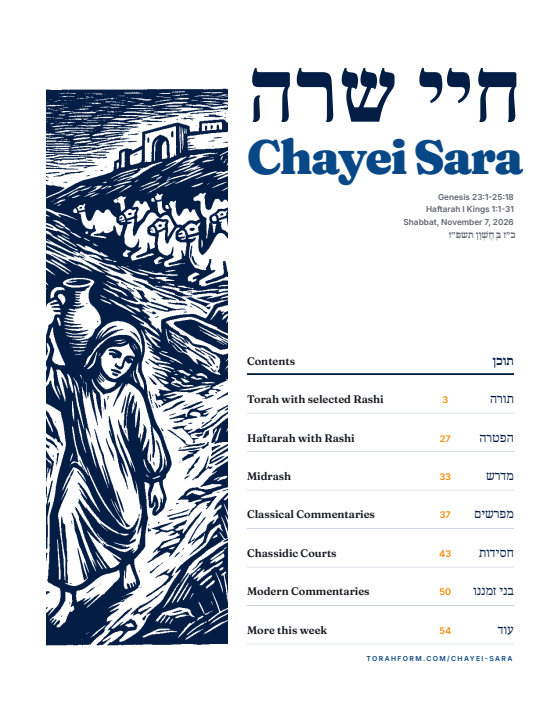
| Woodcut illustrations | drawn by AI in the style of a woodcut |
| Kitzur Shulchan Aruch | Kitzur Shulchan Aruch, trans. Rabbi Avrohom Davis, Metsudah Pub., 1996 (CC-BY), via Sefaria |
| Translated by AI | Arvei Nachal, Avodat Yisrael, Ba'al Shem Tov, Bat Ayin, Beit Aharon, Beit Yisrael (Ruzhin), Chiddushei HaRim on Torah, Degel Machaneh Ephraim, Divrei Emet, Likutei Halakhot, Maor VaShemesh, Mareh Yechezkel on Torah, Me'or Einayim, Noam Elimelekh, Ohev Yisrael, Ohr HaMeir, Peri Tzadik, Sefat Emet, Shem MiShmuel, Tiferet Shlomo, Toldot Yaakov Yosef, Torah Ohr, Yismach Moshe, Zera Kodesh (how) |