קריאהThe readingGenesis 6:9-11:32 · all of it in the booklet
What each aliyah says, with its page in the booklet. The text itself is on Sefaria.
First Aliyah
Noach, called just and perfect in his generations and described as walking with God, is commanded to build an ark with precise specifications to survive the coming flood that will destroy a corrupt and violent earth, bringing with him his family and pairs of every living creature along with sufficient food. Noach's unwavering obedience is emphasized: he did according to all that God commanded him, thus he did.
Second Aliyah
God commands Noaĥ to bring his family and the animals—clean beasts and birds by sevens, others by twos—into the ark in preparation for the forty-day flood, and Noaĥ faithfully obeys every detail of this instruction. Noaĥ and his household enter the ark with all the creatures as commanded, and the Lord Himself seals them inside, marking the onset of the flood.
Third Aliyah
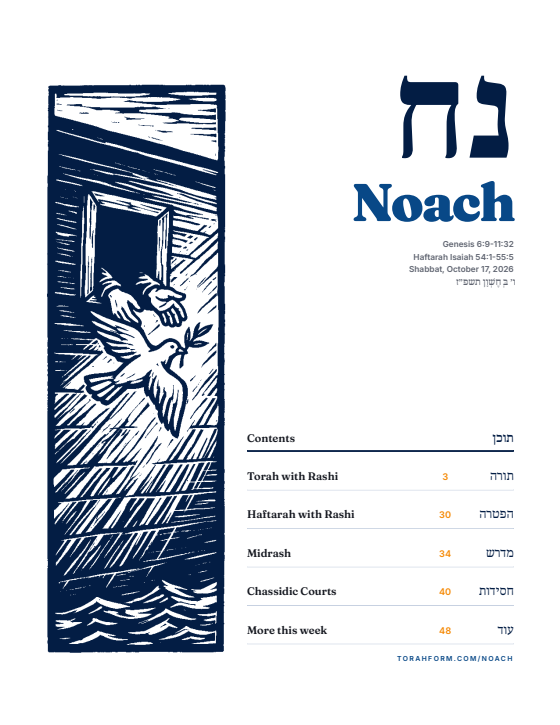
The flood overwhelms the earth completely, destroying all life except Noaĥ and those with him in the ark, yet God remembers Noaĥ and causes the waters to recede gradually, as marked by the mountains' reappearance and the sending forth of the raven and dove. Noaĥ's patient, methodical testing of the earth's dryness—culminating in the dove's olive leaf and final departure—reflects the careful unfolding of divine providence even amid devastation, teaching trust in God's timing for renewal.
Fourth Aliyah
After emerging from the ark, Noaĥ offers korbanot (sacrifices), prompting God to promise never again to destroy the world and to establish the enduring order of the seasons, while blessing Noaĥ and his sons to be fruitful and multiply. God then grants humanity dominion over animals and permission to eat meat, but forbids consuming blood and firmly prohibits murder, affirming that every human being is created b'tzelem Elokim (in the image of God).
Fifth Aliyah
God establishes an eternal covenant with Noaĥ, his descendants, and every living creature, promising never again to destroy the earth by flood, and sets the rainbow in the clouds as the eternal sign (ot) of this covenant between Himself and all flesh. Whenever the bow appears, it serves as a perpetual reminder of God's mercy and His binding promise to preserve creation.
Sixth Aliyah
Ḥam's disrespect toward his father Noaĥ's drunken vulnerability, contrasted with Shem and Yefet's modest and respectful covering of him, determines the blessings and curses that shape the destinies of their descendants. From these three sons descend all the nations of the earth, each spreading into its lands, languages, and families after the flood.
Seventh Aliyah
Humanity's unified language and ambition to build a city and tower reaching the heavens, driven by a desire to "make a name" and avoid dispersion, led God to confound their speech and scatter them across the earth, giving Bavel (Babel) its name. The ensuing genealogy from Shem through Teraĥ traces the lineage leading to Avram, setting the stage for his journey toward Kena῾an.
Maftir
Terach sets out from Ur-kasdim with Avram, Saray, and Lot to journey toward the land of Kena'an, yet he stops short and settles in Charan, where he dies, leaving the family's destined migration incomplete until Avram himself resumes it. Saray's barrenness is noted here, foreshadowing the long road to the fulfillment of the Divine promise of progeny that will unfold through Avram.
Haftarah
God assures Yisra᾽el (Israel), likened to a barren one who will yet bear many children, that His faithful love and covenant of peace endure forever despite the brief anger of exile, promising restoration, security, and glory beyond her former state. Just as water and food are offered freely to the thirsty and hungry, God invites His people to return to Him without cost, renewing the everlasting covenant once given to David and extending His glory to the nations.
מדרשMidrash5 teachings
The classic midrashim on the reading.
Was Noach only good compared to his terrible generation?
Rabbi Yehuda says yes, like the least-spoiled barrel; Rabbi Neḥemya disagrees.
What lit Noah's ark through a year of darkness
Sages debated a window or a glowing stone that dimmed by day, shone by night.
A person's title can rise or fall based on their deeds
Noah sank from "righteous man" to "man of the soil" after planting a vineyard instead of a fig or olive tree.
Why did the Tower of Bavel builders turn violent?
Unable to understand each other's speech, they drew swords and half the world perished.
Real faith is tested, not just claimed after the fact
Haran waited to see who'd win, then died when he faced the same fire.
חסידותFrom the Chassidic Courts26 teachings · 5 in the booklet
One teaching from each court with something to say on Noach, most of them in English nowhere else.
Why did Noach hesitate to believe the flood would come
He feared his own complete faith might itself draw the flood into being.
Why theft alone sealed the Flood generation's fate
Theft silences the inner stirrings—like hunger or pain—that normally awaken teshuvah.
Why calling Noach righteous only in his time is praise
Noach himself believed he wouldn't measure up in Avraham's generation, showing genuine humility.
Why Noach hesitated before entering the ark
He wasn't lacking faith but holding back assent, hoping prayer would still avert the decree.
Why some generations never saw a rainbow
A tzaddik can nullify evil decrees himself, making the rainbow's sign unnecessary.
Even eating and drinking can lift a person higher
Noach stayed righteous through each new level by directing every act, even eating, toward God.
Wholeness means a genuinely broken heart, not self-perfection
Avraham and Moshe reached humility on their own; Noach needed God's help to feel it.
Why daily work can't extinguish the soul's hidden love
Called 'the waters of Noach,' life's burdens purify and raise the soul higher.
How can a verse praise Noach yet also denigrate him?
The Torah calls Noach a tzaddik tamim, so the ligenai reading needs reconciling.
Why finding favor in God's eyes proves Noach studied Torah
Favor comes through 'eyes,' linked to the Name Mah, drawn from Torah studied for its own sake.
Why some righteous people need help to return to God
His name hints that sin rose toward teshuvah, like refining gold to purge evil.
Why anger still has a purpose in this world
The raven hints anger can protect against lust until lust is fully gone.
Why did Noach need an ark instead of just being saved
He too needed the flood's purification, but was enclosed and rectified within the ark for 120 years.
Why Noach stayed the same his whole life
His doubled name hints a tzaddik who feared God but never grew in love
Why does the Torah call Noach 'a man, righteous, perfect'?
The extra word 'man' teaches his perfection was measured by human capacity, not Hashem's infinite standard.
Why did Noach gather food before entering the ark?
It hints that prayer means binding your heart to the wisdom hidden in every creature and thing.
Why did Avraham get credit for twenty generations of failure
Pre-Flood generations left no trace, but post-Flood sparks were gathered by Avraham's ten trials.
Rejected rebuke still enriches the one who gave it
Noach gained completeness by absorbing the good his generation refused to hear.
Why being called stubborn can actually be a compliment
Stiff-necked steadfastness lets captives stay wise and holy even in suffering, drawing the Shechinah near.
What really makes Shabbat rest holy
Guarding speech and joining others face to face unites the three Shabbat meals into one.
Why Noah had to be told to leave the ark
Entering holiness is easy; God also commands going out to sustain the world.
Why did Noach hesitate before entering the ark
Drawing close to sinners' sparks exposes even a tzaddik to worldly allure, risking his focus.
What makes a person's deeds truly for Heaven's sake
Doing mitzvot to unify Shechinah with Hashem renews the soul like a newborn, says Degel Machaneh Ephraim on Shem.
A sin once beyond repentance became repairable
When wisdom's gates opened in Noach's 600th year, even darkness let repentance in.
Why Noach saved only himself, not his whole generation
Noach's rescue came through a single root-level utterance, like Shabbat, while Avraham repaired all ten utterances and saved everyone.
How Noach found light hidden inside a corrupt generation
He read Noach's name as glory, seeing Hashem's hidden kavod even within their evil.
Sources & translations
| Arvei Nachal | translated by AI (anthropic/claude-sonnet-5) |
| Avodat Yisrael | translated by AI (anthropic/claude-sonnet-5) |
| Ba'al Shem Tov | translated by AI (anthropic/claude-sonnet-5) |
| Bat Ayin | translated by AI (anthropic/claude-sonnet-5) |
| Beit Aharon | translated by AI (anthropic/claude-sonnet-5) |
| Beit Yisrael (Ruzhin) | translated by AI (anthropic/claude-sonnet-5) |
| Bereshit Rabbah | The Sefaria Midrash Rabbah, 2022 |
| Chiddushei HaRim on Torah | translated by AI (anthropic/claude-sonnet-5) |
| Degel Machaneh Ephraim | translated by AI (anthropic/claude-sonnet-5) |
| Divrei Emet | translated by AI (anthropic/claude-sonnet-5) |
| Esh Kodesh | translated by AI (anthropic/claude-sonnet-5) |
| Irin Kadishin | translated by AI (anthropic/claude-sonnet-5) |
| Kedushat Levi | Kedushat Levi translated by Rb. Eliyahu Munk |
| Likutei Halakhot | translated by AI (anthropic/claude-sonnet-5) |
| Likutei Moharan | Likutey Moharan Volumes 1-11, trans. by Moshe Mykoff. Breslov Research Inst., 1986-2012 |
| Maor VaShemesh | translated by AI (anthropic/claude-sonnet-5) |
| Mareh Yechezkel on Torah | translated by AI (anthropic/claude-sonnet-5) |
| Me'or Einayim | translated by AI (anthropic/claude-sonnet-5) |
| Mei HaShiloach | Living waters, the Mei HaShiloach. Trans. and edited by Betsalel Philip Edwards, Jerusalem, J. Aronson 2001 [Revised digital edition, 2021] |
| Noam Elimelekh | translated by AI (anthropic/claude-sonnet-5) |
| Ohev Yisrael | translated by AI (anthropic/claude-sonnet-5) |
| Ohr HaMeir | translated by AI (anthropic/claude-sonnet-5) |
| Or HaChaim | Or Hachayim, trans. Eliyahu Munk |
| Peri Tzadik | translated by AI (anthropic/claude-sonnet-5) |
| Pirkei DeRabbi Eliezer | Pirke de Rabbi Eliezer, trans. Rabbi Gerald Friedlander, London, 1916 |
| Ramban | Commentary on the Torah by Ramban (Nachmanides). Translated and annotated by Charles B. Chavel. New York, Shilo Pub. House, 1971-1976 |
| Rashi | Pentateuch with Rashi's commentary by M. Rosenbaum and A.M. Silbermann, 1929-1934 |
| Sefat Emet | translated by AI (anthropic/claude-sonnet-5) |
| Shem MiShmuel | translated by AI (anthropic/claude-sonnet-5) |
| Tiferet Shlomo | translated by AI (anthropic/claude-sonnet-5) |
| Toldot Yaakov Yosef | translated by AI (anthropic/claude-sonnet-5) |
| Torah Ohr | translated by AI (anthropic/claude-sonnet-5) |
| Torah and Haftarah | The Koren Jerusalem Bible |
| Woodcut illustrations | drawn by AI (google/gemini-3.1-flash-image) from scenes written by AI (anthropic/claude-opus-5.5), in the style of a reference drawn by AI (openai/gpt-5-image-mini) |
| Yismach Moshe | translated by AI (anthropic/claude-sonnet-5) |
| Zera Kodesh | translated by AI (anthropic/claude-sonnet-5) |