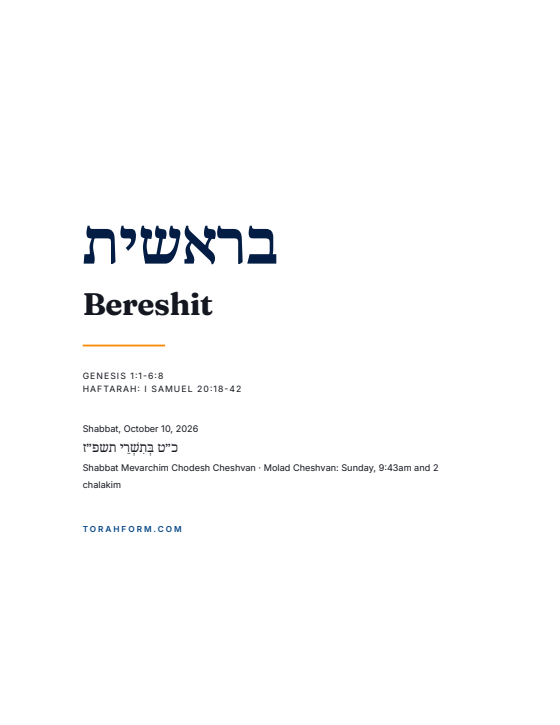
קריאהThe readingGenesis 1:1-6:8 · all of it in the booklet
What each aliyah says, with its page in the booklet. The text itself is on Sefaria.
First Aliyah
God brings forth the entire ordered universe through speech alone, culminating in Mankind, created in the image of God and given dominion over all creation, with every stage declared "good" and the whole very good. On the seventh day God ceases from creation and blesses and sanctifies it, establishing the model for Shabbat (Sabbath) as a day of holiness rooted in the completion of the world.
Second Aliyah
Hashem (God) forms adam (man) from the dust of the earth, breathes into him the breath of life, and places him in the Garden of Eden to work it and guard it, permitting him all its fruit save that of the tree of knowledge of good and evil, on pain of death. Recognizing that man should not be alone, Hashem brings the animals before him so that he names each one, reflecting his unique role and dominion within creation.
Third Aliyah
Eve is formed from Adam's side to become his equal counterpart, establishing marriage as the union of man and wife into "one flesh." Through the serpent's enticement and the eating of the forbidden fruit, sin, shame, and mortality enter the world, bringing consequences of pain, toil, and the curse upon the ground, yet God's mercy is shown in clothing the man and woman despite their transgression.
Fourth Aliyah
Adam and Chavah are exiled from Eden after eating from the tree of knowledge, with the keruvim (cherubim) and revolving sword placed to guard the way back to the tree of life. Their son Qayin, overcome by jealousy and anger when his offering is rejected while Hevel's is accepted, murders his brother and is condemned to a life of wandering, though God protects him from being killed in turn and marks the beginning of his line through Ḥanokh and his descendants.
Fifth Aliyah
Lemekh's two wives, Ada and Żilla, bear children who become the progenitors of civilization's foundational arts: Yaval fathers nomadic herding and tent-dwelling life, Yuval fathers music through the lyre and pipe, and Tuval-qayin fathers metalworking in brass and iron. Even within the morally troubled line of Qayin (Cain), the Torah credits humanity's early cultural and technological development—herding, music, and craftsmanship—to this family.
Sixth Aliyah
Lemekh's boastful song of violence stands in contrast to the renewal of humanity through Shet and Enosh, whose generations mark the beginning of calling upon God's name; the ensuing genealogy from Adam through Ḥanokh traces humanity's descent as beings created in the Divine likeness, culminating in Ḥanokh, who "walked with God" and was taken by Him rather than dying in the ordinary way.
Seventh Aliyah
Human wickedness spreads until all the impulses of man's heart are evil continually, prompting the Lord to resolve to destroy all flesh from the earth; yet amid this corruption, Noaĥ alone finds favor in the eyes of the Lord.
Haftarah
Yehonatan risks his father Sha᾽ul’s fury to confirm, through the sign of the arrows, that the king is bent on killing David, and warns his beloved friend to flee for his life. Their parting is sealed with weeping and a renewed covenant invoking the Lord as eternal witness between themselves and their descendants, showing loyalty and love transcending even the claims of royal succession.
מדרשMidrash5 teachings · 2 in the booklet
The classic midrashim on the reading.
God used the Torah as the blueprint for creation
Like a king's architect works from plans, God looked into Torah, called "reshit," to create the world.
Angels argued over creating humans, truth said no
God threw truth to earth to settle the angels' debate, then restored it.
Why breathing itself is a form of praise
Soul has five names; even in sleep it warms the body, so each breath praises God.
How Cain's lie was exposed despite his denial
Like stained hands or a bleating goat, the evidence betrayed Cain's guilt.
Why Adam didn't receive the Torah or twelve tribes
He couldn't keep six mitzvot and one son killed the other, so God reserved these for his descendants.
חסידותFrom the Chassidic Courts21 teachings · 7 in the booklet
One teaching from each court with something to say on Bereshit, most of them in English nowhere else.
Why repentance can reach a level even tzaddikim lack
Chavah's name uses a vav, not a yud, hinting her teshuvah bound her to life's supernal root.
Rising higher always requires first becoming nothing
Yuval's song shows this inner bittul; Yaval shows it can descend into shepherding.
Why God longs for human effort on Shabbat
Finding favor brings true rest, and human service below—unlike angels above—establishes God's kingship.
Why did earlier worlds fail while ours endures
Like Avraham calling himself dust and ashes, true humility before Hashem sustains the world.
Why does Torah study at feasts need no special subject?
True Torah mastery transforms a person's essence, letting set study overcome temptation even at feasts.
One righteous person's goodness holds up the whole world
The tzaddik links every level from Aleph to Tav, lifting all worlds like a foundation.
Why didn't God create the world sooner
Just as Shabbat must follow six days, creation came at its precise, eternally willed time.
Why does the Torah open with creation instead of law?
Since Hashem made the world, He alone decides who receives each land, not conquest.
God favors kindness to Israel over strict judgment
Tohu symbolizes the wicked's deeds; light symbolizes the righteous, which God calls good.
Why full awareness during intimacy can cause spiritual harm
Adam's conscious thought of Chavah as wife, say the text, led to Kayin's impurity.
True greatness reveals itself by lowering down for others
God made the world for Torah and Israel, both called reishit, contracting Himself to give life.
Why today's tzaddik still matters even without ancient stature
Later tzaddikim plead leniently for Yisrael, and their prayers are still cherished above.
Why does being made in God's image matter
Like God contains and causes all things, man is composed of everything and is creation's purpose.
The real light of creation is tzaddikim uplifting sinners
On Yom Kippur we pray together with sinners, raising them into a new creation.
Cain's curse was confused thought, not loss of free choice
Shabbat, a glowing horn, or a dog each show a different level of restored protection.
God asks why Cain is jealous, not inferior
True service is measured by your own yearning, not by comparing yourself to your brother's offering.
Why God's plan seemingly shifted from strict judgment to mercy
Higher worlds bear strict din; our actual world needed rachamim, like tzaddikim judged by a hairsbreadth.
Why this lowly world is the only place teshuvah works
Greater concealment brings greater mercy; higher worlds judge strictly, with no room to repent.
Why could Abraham keep the whole Torah before Sinai
Torah was first one voice, like souls held in Adam before dividing into 600,000.
Why aim for strict justice even knowing you'll fall short
Intend to fulfill everything by strict judgment; only then does mercy step in to complete the deed.
Why a fool's wife often seems beautiful
Overflowing marrow from his bones gives her hidden wisdom, which lights up her face.
Sources & translations
| Arvei Nachal | translated by AI (anthropic/claude-sonnet-5) |
| Avodat Yisrael | translated by AI (anthropic/claude-sonnet-5) |
| Ba'al Shem Tov | translated by AI (anthropic/claude-sonnet-5) |
| Bat Ayin | translated by AI (anthropic/claude-sonnet-5) |
| Beit Aharon | translated by AI (anthropic/claude-sonnet-5) |
| Beit Yisrael (Ruzhin) | translated by AI (anthropic/claude-sonnet-5) |
| Bereshit Rabbah | The Sefaria Midrash Rabbah, 2022 |
| Chiddushei HaRim on Torah | translated by AI (anthropic/claude-sonnet-5) |
| Degel Machaneh Ephraim | translated by AI (anthropic/claude-sonnet-5) |
| Divrei Emet | translated by AI (anthropic/claude-sonnet-5) |
| Esh Kodesh | translated by AI (anthropic/claude-sonnet-5) |
| Kedushat Levi | translated by AI (anthropic/claude-sonnet-5) |
| Maor VaShemesh | translated by AI (anthropic/claude-sonnet-5) |
| Mareh Yechezkel on Torah | Rabbi Francis Nataf, 2021 |
| Me'or Einayim | translated by AI (anthropic/claude-sonnet-5) |
| Mei HaShiloach | Living waters, the Mei HaShiloach. Trans. and edited by Betsalel Philip Edwards, Jerusalem, J. Aronson 2001 [Revised digital edition, 2021] |
| Noam Elimelekh | translated by AI (anthropic/claude-sonnet-5) |
| Ohev Yisrael | translated by AI (anthropic/claude-sonnet-5) |
| Ohr HaMeir | translated by AI (anthropic/claude-sonnet-5) |
| Or HaChaim | Or Hachayim, trans. Eliyahu Munk |
| Peri Tzadik | translated by AI (anthropic/claude-sonnet-5) |
| Ramban | Commentary on the Torah by Ramban (Nachmanides). Translated and annotated by Charles B. Chavel. New York, Shilo Pub. House, 1971-1976 |
| Rashi | Pentateuch with Rashi's commentary by M. Rosenbaum and A.M. Silbermann, 1929-1934 |
| Sefat Emet | translated by AI (anthropic/claude-sonnet-5) |
| Shem MiShmuel | translated by AI (anthropic/claude-sonnet-5) |
| Sichot HaRan | Rabbi Nachman's Wisdom, trans. Aryeh Kaplan, Jerusalem. Breslov Research Institute, 1973 |
| Tiferet Shlomo | translated by AI (anthropic/claude-sonnet-5) |
| Toldot Yaakov Yosef | translated by AI (anthropic/claude-sonnet-5) |
| Torah Ohr | translated by AI (anthropic/claude-sonnet-5) |
| Torah and Haftarah | The Koren Jerusalem Bible |
| Yismach Moshe | translated by AI (anthropic/claude-sonnet-5) |
| Zera Kodesh | translated by AI (anthropic/claude-sonnet-5) |